

Overview
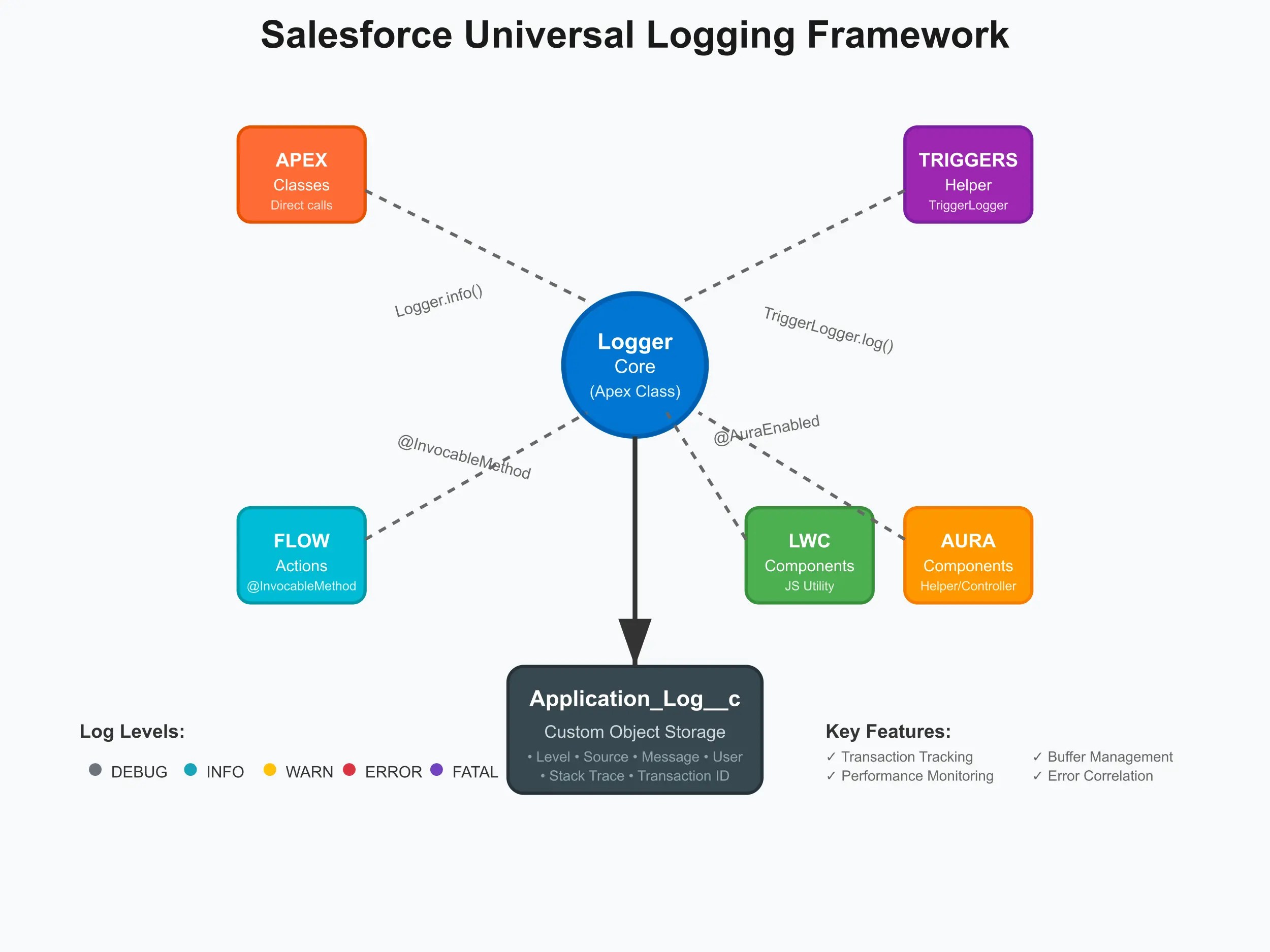
This comprehensive logging framework provides a unified way to log messages, errors, and debugging information across all Salesforce platforms including Apex, Triggers, Flows, Lightning Web Components (LWC), and Aura Components.
Features
- Universal Coverage: Works across Apex, Triggers, Flows, LWC, and Aura
- Configurable Log Levels: DEBUG, INFO, WARN, ERROR, FATAL
- Transaction Tracking: Groups related logs with unique transaction IDs
- Buffer Management: Optimises performance with intelligent batching
- Rich Context: Captures user, record, source, and additional metadata
- Performance Monitoring: Built-in performance logging capabilities
- Error Handling: Comprehensive error logging with stack traces
Setup Instructions
1. Create Custom Object: Application_Log__c
Create a custom object with the following fields:
| Field Name | Type | Length | Description |
|---|---|---|---|
| Level__c | Picklist | – | Values: DEBUG, INFO, WARN, ERROR, FATAL |
| Source__c | Text | 255 | Source platform (Apex, Flow, Trigger, LWC, Aura) |
| Component_Name__c | Text | 255 | Class.Method name or Flow name |
| Message__c | Long Text Area | 32,768 | Log message content |
| Stack_Trace__c | Long Text Area | 32,768 | Stack trace for errors |
| User__c | Lookup | – | User who triggered the log |
| Record_Id__c | Text | 18 | Related record ID |
| Transaction_Id__c | Text | 255 | Unique transaction identifier |
| Additional_Data__c | Long Text Area | 32,768 | JSON formatted additional data |
2. Deploy Apex Classes
Deploy the following Apex classes:
Logger.cls– Main logging utilityTriggerLogger.cls– Trigger-specific logging helperFlowLogger.cls– Flow invocable methodsLoggerController.cls– Controller for LWC/Aura
3. Create Lightning Web Component
Create a Lightning Web Component named logger with the logging utility JavaScript.
4. Set Permissions
Grant the following permissions to users:
- Read/Write access to Application_Log__c object
- Execute access to LoggerController class
- Access to FlowLogger invocable methods


Usage Examples
Apex Classes
public class ExampleUsage {

    public void demonstrateLogging() {
        // Simple logging
        Logger.info('Process started');
        Logger.debug('ExampleUsage.demonstrateLogging', 'Debug information');

        try {
            // Some business logic
            performBusinessLogic();
            Logger.info('ExampleUsage.demonstrateLogging', 'Business logic completed successfully');
        } catch (Exception ex) {
            Logger.error('ExampleUsage.demonstrateLogging', ex);
            Logger.fatal('ExampleUsage.demonstrateLogging', 'Critical error occurred');
        } finally {
            Logger.flush(); // Ensure logs are written
        }
    }

    private void performBusinessLogic() {
        // Simulate some processing
        Logger.debug('ExampleUsage.performBusinessLogic', 'Starting business logic');

        // Simulate an error
        throw new CalloutException('Simulated error for demonstration');
    }
}
Triggers
trigger AccountTrigger on Account (before insert, before update, after insert, after update) {

    TriggerLogger.logTriggerStart('Account', String.valueOf(Trigger.operationType));

    try {
        if (Trigger.isBefore && Trigger.isInsert) {
            for (Account acc : Trigger.new) {
                Logger.debug('AccountTrigger', 'Processing new account: ' + acc.Name);
                // Trigger logic here
            }
        }

        TriggerLogger.logTriggerEnd('Account', String.valueOf(Trigger.operationType), Trigger.size());

    } catch (Exception ex) {
        TriggerLogger.logTriggerError('Account', String.valueOf(Trigger.operationType), ex);
        Logger.flush();
        throw ex;
    }

    Logger.flush();
}
Lightning Web Components
<template>
    <lightning-card title="Logger Test Component" icon-name="custom:custom14">
        <div class="slds-m-around_medium">

            <lightning-button-group>
                <lightning-button label="Test Debug Log" onclick={handleDebugLog} class="slds-m-right_small">
                </lightning-button>
                <lightning-button label="Test Info Log" onclick={handleInfoLog} class="slds-m-right_small">
                </lightning-button>
                <lightning-button label="Test Error Log" onclick={handleErrorLog} class="slds-m-right_small">
                </lightning-button>
                <lightning-button label="Load Data" onclick={handleLoadData} class="slds-m-right_small">
                </lightning-button>
                <lightning-button label="Simulate Error" onclick={handleSimulateError} variant="destructive">
                </lightning-button>
            </lightning-button-group>

            <template if:true={data}>
                <div class="slds-m-top_medium">
                    <h3>Data Loaded:</h3>
                    <template for:each={data} for:item="item">
                        <p key={item.id}>{item.name}</p>
                    </template>
                </div>
            </template>

            <template if:true={error}>
                <div class="slds-m-top_medium">
                    <lightning-formatted-text value={error} class="slds-text-color_error">
                    </lightning-formatted-text>
                </div>
            </template>
        </div>
    </lightning-card>
</template>
import { LightningElement, api, track } from 'lwc';
import logger from 'c/logger';

export default class ExampleLogComponent extends LightningElement {
    @api recordId;
    @track data = [];
    @track error;

    async connectedCallback() {
        // Initialize logger with component name
        logger.setComponentName('ExampleLogComponent');

        // Log component initialization
        await logger.info('Component initialized', this.recordId, {
            timestamp: new Date().toISOString(),
            userAgent: navigator.userAgent
        });
    }

    disconnectedCallback() {
        // Log component destruction
        logger.logSync('INFO', 'Component disconnected', this.recordId);
    }

    async handleDebugLog() {
        await logger.debug('Debug button clicked', this.recordId, {
            buttonType: 'debug',
            clickTime: new Date().toISOString()
        });
    }

    async handleInfoLog() {
        await logger.info('Info button clicked', this.recordId, {
            buttonType: 'info',
            clickTime: new Date().toISOString()
        });
    }

    async handleErrorLog() {
        await logger.error('Manual error log triggered', this.recordId, {
            buttonType: 'error',
            clickTime: new Date().toISOString()
        });
    }

    async handleLoadData() {
        const startTime = performance.now();
        this.error = null;

        try {
            await logger.debug('Starting data load operation', this.recordId);

            // Simulate API call
            const result = await this.fetchData();
            this.data = result;

            const endTime = performance.now();
            await logger.logPerformance('Data Load', endTime - startTime, {
                recordCount: result.length,
                recordId: this.recordId
            });

            await logger.info('Data loaded successfully', this.recordId, {
                recordCount: result.length,
                loadTime: endTime - startTime
            });

        } catch (error) {
            await logger.logError(error, 'handleLoadData', this.recordId);
            this.error = error.message;
        }
    }

    async handleSimulateError() {
        try {
            await logger.warn('About to simulate an error', this.recordId);

            // Intentionally throw an error
            throw new Error('This is a simulated error for testing logging');

        } catch (error) {
            await logger.logError(error, 'handleSimulateError', this.recordId);
            this.error = error.message;
        }
    }

    async fetchData() {
        // Simulate async data loading
        return new Promise((resolve, reject) => {
            setTimeout(() => {
                if (Math.random() > 0.8) {
                    reject(new Error('Simulated API error - network timeout'));
                } else {
                    resolve([
                        { id: '1', name: 'Item 1' },
                        { id: '2', name: 'Item 2' },
                        { id: '3', name: 'Item 3' }
                    ]);
                }
            }, 1000);
        });
    }

    // Error handler for unexpected errors
    errorCallback(error, stack) {
        logger.logSync('FATAL', `Unexpected component error: ${error.message}`, this.recordId, {
            stack: stack,
            component: 'ExampleLogComponent',
            timestamp: new Date().toISOString()
        });
    }
}
Flows
- Add an Action element to your Flow
- Search for “Log Message”
- Configure inputs:
- Flow Name: “My_Flow_Name”
- Level: “INFO”
- Message: “Flow step completed successfully”
- Record Id:
{!recordId}(optional)
Configuration Options
Log Levels
Configure the minimum log level by modifying MIN_LOG_LEVEL In the Logger class:
private static final LogLevel MIN_LOG_LEVEL = LogLevel.INFO_LEVEL; // Only INFO and above
Buffer Size
Adjust buffer size for performance optimisation:
private static final Integer MAX_BUFFER_SIZE = 100; // Increase for better performance
Enable/Disable Logging
Control logging programmatically:
Logger.disable(); // Turn off all logging
Logger.enable();  // Turn on logging
Advanced Features
Transaction Tracking
All logs within a single transaction are automatically grouped with a unique transaction ID. You can also set custom transaction IDs:
Logger.setTransactionId('BATCH_JOB_001');
Logger.info('Custom transaction started');
Performance Logging
Track method execution times:
public void performanceExample() {
    Long startTime = System.currentTimeMillis();

    // Your business logic here
    performComplexOperation();

    Long endTime = System.currentTimeMillis();
    Logger.info('MyClass.performanceExample', 'Operation completed in ' + (endTime - startTime) + 'ms');
}
Structured Logging with Additional Data
Log complex data structures:
Map<String, Object> contextData = new Map<String, Object>{
    'batchSize' => 100,
    'retryCount' => 3,
    'environment' => 'Production'
};

Logger.info('BatchProcessor.execute', 'Batch processing started', JSON.serialize(contextData));
Error Correlation
Link errors to specific records for easier troubleshooting:
try {
    processAccount(accountId);
} catch (Exception ex) {
    Logger.error('AccountProcessor.processAccount', ex.getMessage());
    // Log additional context with the record ID
    Logger.error('AccountProcessor.processAccount', 'Failed to process account: ' + accountId);
}
Best Practices
1. Use Appropriate Log Levels
- DEBUG: Detailed information for debugging (development only)
- INFO: General information about application flow
- WARN: Warning messages about potential issues
- ERROR: Error conditions that don’t stop execution
- FATAL: Critical errors that may cause system failure
2. Include Context Information
Always include relevant context:
Logger.info('OrderProcessor.processOrder',
    'Processing order for customer: ' + customerId +
    ', Order ID: ' + orderId +
    ', Amount:  + orderAmount);
3. Flush Logs Appropriately
Flush logs at logical boundaries:
// In batch jobs
Logger.flush(); // After each batch

// In triggers
Logger.flush(); // At the end of trigger execution

// In long-running processes
if (Math.mod(processedCount, 100) == 0) {
    Logger.flush(); // Every 100 records
}
4. Handle Sensitive Data
Avoid logging sensitive information:
// DON'T do this
Logger.debug('User password: ' + password);

// DO this instead
Logger.debug('User authentication attempted for: ' + username);
5. Use Meaningful Messages
Write clear, actionable log messages:
// Poor message
Logger.error('Error occurred');

// Good message
Logger.error('AccountTrigger.validateAccount',
    'Account validation failed: Missing required field Industry for Account: ' + accountId);
Monitoring and Reporting
Create Reports and Dashboards
- Error Trend Report: Track error frequency over time
- Performance Dashboard: Monitor system performance metrics
- User Activity Report: Track user actions and patterns
- Component Health Dashboard: Monitor component-specific issues
Sample SOQL Queries
-- Get all errors from last 24 hours
SELECT Id, Level__c, Source__c, Class_Method__c, Message__c, CreatedDate, User__r.Name
FROM Application_Log__c
WHERE Level__c = 'ERROR' AND CreatedDate = LAST_N_DAYS:1
ORDER BY CreatedDate DESC

-- Get transaction logs
SELECT Id, Level__c, Message__c, CreatedDate
FROM Application_Log__c
WHERE Transaction_Id__c = 'your_transaction_id'
ORDER BY CreatedDate ASC

-- Performance analysis
SELECT Class_Method__c, COUNT(Id) LogCount, AVG(CreatedDate) AvgTime
FROM Application_Log__c
WHERE Message__c LIKE '%completed in%'
GROUP BY Class_Method__c
Automated Monitoring
Set up Process Builder or Flow to:
- Send email alerts for FATAL errors
- Create cases for recurring errors
- Notify administrators of system issues
Troubleshooting
Common Issues
- Logs not appearing: Check object permissions and field-level security
- Performance issues: Reduce buffer size or increase flush frequency
- Too many logs: Implement log level filtering in production
- Missing context: Ensure transaction IDs are properly set
Debug Mode
Enable detailed debugging:
// Temporary debug logging
Logger.debug('DetailedClass.complexMethod', 'Variable X value: ' + variableX);
Logger.debug('DetailedClass.complexMethod', 'Loop iteration: ' + i + ', Current record: ' + recordId);
Maintenance
Regular Cleanup
Implement automated cleanup to manage log volume:
// Delete logs older than 90 days
DELETE [SELECT Id FROM Application_Log__c WHERE CreatedDate < LAST_N_DAYS:90];
Archival Historical Data
For compliance, consider archiving logs to external systems before deletion.
Performance Optimization
Monitor and optimize:
- Log volume vs. system performance
- Buffer size effectiveness
- Query performance on log objects
Security Considerations
- Field-Level Security: Restrict access to sensitive log data
- Sharing Rules: Implement appropriate sharing for log records
- Data Classification: Mark log fields according to data sensitivity
- Retention Policies: Define and implement log retention policies
Integration with External Systems
Splunk Integration
Export logs to Splunk for advanced analytics:
// Custom callout to send logs to external system
Http http = new Http();
HttpRequest request = new HttpRequest();
request.setEndpoint('https://your-splunk-instance.com/api');
request.setMethod('POST');
request.setBody(JSON.serialize(logData));
This logging framework provides a robust foundation for monitoring, debugging, and maintaining your Salesforce applications across all platforms. Customise it according to your organisation’s specific needs and compliance requirements.
Code Repo
You can access the code base from the “logger-framework-Salesforce” repo.

One thought on “Salesforce Universal Logging Framework”
Comments are closed.